â€å“if You Don t Like Our President You Can Leave and Never Come Back Again
—
deconstructing the deep state
Donald Trump isn't the outset president to be deeply skeptical of the institutions and people he now leads
A month after President Trump took the oath of office, his chief strategist offered a controversial clarification of what Americans, including the 2 one thousand thousand career civil servants Trump now leads in the executive branch, could await from the new president: Every day would be a battle for "deconstruction of the administrative state," said Stephen Bannon, the man oft described every bit the mastermind behind Trump'south nationalist agenda.
Bannon is no longer in the White Business firm, but his remarks at a conservative political conference in Feb go along to reverberate through government.
Some interpreted Bannon's annotate as a reference to Trump'southward classic Republican goals of reducing regulations, cutting taxes and shrinking government. But in a Manichean oral communication in Warsaw, Poland, in July, Trump warned of a danger "invisible to some just familiar to the Poles: the steady pitter-patter of authorities bureaucracy that drains the vitality and wealth of the people."
As the Trump era has unfolded, the term "deep state" has come to mean something sinister to some on the far right. More than simply signifying an impersonal, inept bureaucracy, it conjures a secretive illuminati of bureaucrats determined to sabotage the Trump calendar.
On the pro-Trump Mark Levin radio show, commentator Dan Bongino decried the ongoing investigation of Trump'south ties to the Russians during the 2016 campaign, proverb, "They want a scalp, and believe me when I tell you the deep state is going to become one."
Trump is being attacked, said a memo from a National Security Council staffer published in August past Foreign Policy, considering he represents "an existential threat to cultural Marxist memes that dominate the prevailing cultural narrative." Those threatened by Trump include "deep state actors, globalists, bankers, Islamists, and establishment Republicans."
In July, Breitbart News—where Bannon presided earlier joining the Trump presidential campaign in August 2016, and to which he immediately returned later on his departure from the White Business firm a year later—publicized a study from the Senate Homeland Security and Governmental Diplomacy Commission saying Trump faced 7 times more leaks during the first 126 days of his administration than the previous two administrations.
"How many strange allies are pulling dorsum?" asked the Wall Street Periodical's Kimberley Strassel in a column titled "Washington's Leak Mob." "How many will work with a U.S. government that has disclosed and so many military plans, weapons systems and cybersecurity tactics?"
A Hostile Takeover
Even before he took the oath of function, Trump took to Twitter to narrate suspected leakers in the intelligence customs every bit behaving like Nazis. At the Justice Department, Attorney General Jeff Sessions in August issued a loud alert to would-be leakers, even every bit some career Justice staff connected spilling to the media their worries about Sessions' policy reversals on such problems as immigration and affirmative action.
Also enlisting in the war confronting the deep state are right-leaning legal activists who use the Freedom of Information Human activity to target disgruntled career federal workers who apply encrypted software to make bearding political commentary unflattering to Trump.
But to many with years in government, the term "deep land" is disturbing. "Deep state is both inaccurate and grossly misleading," said Nancy McEldowney, who retired in June as managing director of the Arlington, Va.-based Foreign Service Found. "The term originated in the context of analyzing the situations in Turkey and Arab republic of egypt, where I served, commonly to talk nearly propaganda, dirty tricks, and even violence to overthrow the government," she said.
"To refer to career civil servants in the U.Due south. government every bit some form of deep state is a articulate endeavor to delegitimize voices of disagreement," she added. "Even worse, information technology carries with it the potential for fear-baiting and rumor-mongering, and is really a dark conspiratorial term that does not correspond to reality."
Chris Lu, President Obama's deputy Labor secretary, rejects the notion that some entrenched deep state is undermining Trump'due south political appointees. "The politicals set the management of the agency, but they tin can only practice it effectively if they tap into the expertise of the federal civil service," he said.
Lu, now a senior fellow at the Academy of Virginia Miller Center of Public Affairs, says it's important to recall why the civil service was created under the 1883 Pendleton Deed. "Before then, in that location were stories of the amounts of time [President] Lincoln spent meeting with chore seekers, with ads in Washington newspapers selling jobs nether the spoils system and the tradition of incoming administrations kicking everyone out," he said. Creation of the civil service was "one of the virtually of import reforms of the past century and a one-half, and is one reason the federal regime is still the almost important and powerful organization in the world."
But if the Trump team is misreading how government works, it is non the first new assistants to practice then. Every new president brings into office political appointees who are wary of "bureaucrats," said Paul Light, Paulette Goddard Professor of Public Service at New York Academy. "Democrats historically have been every bit reluctant to work with careerists every bit Republicans, not because of the ideology but considering of the desire for speed."

To refer to career civil servants in the U.S. government as some class of deep country is a clear attempt to delegitimize voices of disagreement. Fifty-fifty worse, it carries with it the potential for fear-baiting and rumor-mongering, and is actually a dark conspiratorial term that does not correspond to reality.
nancy mceldowney, one-time manager of the foreign service institute
Democrats more often than not understand they will need federal employees to implement their policies, "though they may believe that those employees need to be liberated from rules," Light added. "Republicans accept the aforementioned hierarchy, just are motivated by a different goal. Both parties in the by have "come in maxim, 'We've got an agenda; nosotros've got four years, peradventure 8, so we can't wait for activeness.' "
In the Trump assistants, Light noted, many may concur with Bannon's concept of a deep state, but are uncomfortable with that linguistic communication.

Others are skeptical that many in Trump's circles actually buy into the notion of a deep state. "If they had this theory of the deep country and were worried, the get-go thing they would do is appoint a lot of political appointees," said Donald Devine, who headed the Office of Personnel Management in the Reagan administration.
Norm Ornstein, a longtime observer of Washington at the American Enterprise Institute, is appalled at what he sees as Bannon'due south promotion of a "conspiracy theory of lawless people trying to undermine American values for their own warped sense and defying laws and property."
In fact, Ornstein said, "we have career people and some political appointees who've been at that place some time who are essential to the performance of regime. They've been there through many administrations and have their own policy interests." Then yes, there is that spider web of people. "Just my feel over many decades is that overwhelmingly they understand their role, and whether they like the policies or not, they follow the pb of administrations."
In recent decades, there's been "significant harm done," Ornstein added, "in that when there's a change in party, the newcomers tend to view many of those career people working for previous administrations as traitors yous desire to force out. The tensions are greater now in the era of polarized politics."
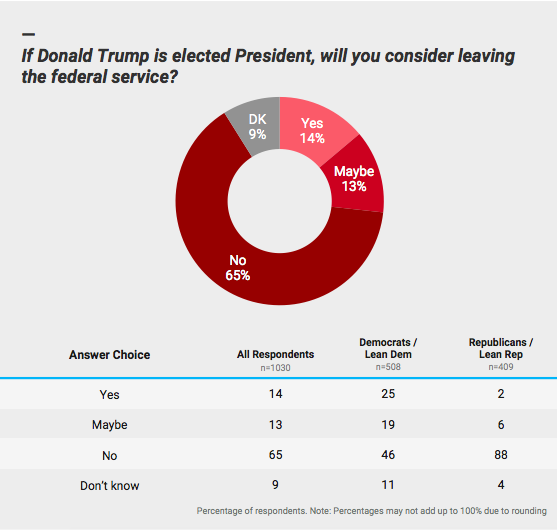
Entrada donations from federal employees for the 2016 cycle skewed toward Democrats, in some agencies by a factor of 10-to-one, according to the Middle for Responsive Politics. In recent months, the news media, which Trump often derides as "fake," take published numerous essays and interviews with disgruntled federal employees, including one from a erstwhile State Department employee who accused Secretary Male monarch Tillerson of an "inherent distrust of the State Department and career officers."
And when Sessions in August appear a reversal of Justice'south position on a instance involving Ohio's effort to purge rolls of inactive voters, career staff who had signed a related brief during the Obama years did not put their names on the Trump version.
Many of Trump's staff and appointees had experience in previous Republican administrations, where, to varying degrees, political appointees came into agencies with an agenda to shrink the bureaucracy and brand authorities less intrusive.
An Agenda With a Precedent
Indeed, President Reagan's "government is the trouble" theme had its heyday only three years later Democratic President Jimmy Carter had worked with Congress to enact the 1978 Civil Service Act, largely as an effort to professionalize government.
Devine, who ran personnel-related issues for Reagan's transition team earlier becoming OPM director, recalls the scene in 1981 as one in which "unions were threatening job actions, and either sitting with their arms folded or not showing upwards." Eventually, later on federal air traffic controllers went on strike and Reagan fired them, "those job actions stopped."
Almost ceremonious servants disliked Reagan. Devine, at present a higher professor, remembers an early voice communication on cutting bureaucracy he delivered to the American Society for Public Administration. Information technology drew loud boos and multiple requests for printed copies. "My dealings with the hierarchy showed me their kickoff priorities were maintaining the condition quo in their agencies, and they were certainly not Republicans," he said.
The Reagan years, much like today, brought to Washington many appointees to run agencies charged with missions the appointees don't endorse. I such instance is Anne Gorsuch Burford, Reagan's Environmental Protection Agency ambassador. In 1981, with Reagan's blessing, she began implementing a 22 percent budget cutting and slashed regulations. After a scandal surrounding the $1.6 billion hazardous waste matter superfund cleanup plan, she was cited for contempt of Congress. (Though Burford wouldn't have mentioned a deep land, she did say later that Washington was "as well small to exist a state but too big to be an asylum for the mentally deranged.")
My dealings with the bureaucracy showed me their first priorities were maintaining the status quo in their agencies, and they were certainly not Republicans.
donald devine, former head of the office of personnel management
Career employees working under Burford think the pressure level she was under to please Reagan campaign donors such every bit the Colorado-based Joseph Coors beer family unit, and how Budget Director David Stockman would target programs for elimination without any argue. "I received a telephone call from my boss'southward deputy less than a calendar month after the inauguration telling me my noise control plan was being abolished, and the decision was not appealable," recalled Chuck Elkins, who spent 25 years at EPA. "We regulated an industry for their noise, and one of the manufacturers had complained to Stockman."
During the Reagan transition, Elkins attended a meeting where political appointees spoke frankly about favoring manufacture, he told Government Executive. He was deeply committed to the plan'south mission, and the bulletin from the new administration was disturbing. "My commencement reaction was 'we tin't lose this,' " Elkins said. Just shortly his thoughts turned to the 100 people who would lose their jobs at a time when he himself had two kids in college. He responded by setting upwardly a clinic on resume writing. Shortly most employees found jobs with the Navy or the Interior Department, where Elkins did a stint before eventually returning to EPA to work in other areas.
Burford feared the bureaucracy plenty to compile "an enemies list," recalled Elkins' colleague Ed Hanley. He recalled being summoned by EPA's interim boss and handed "a yellow buck slip with seven names, all career," with instructions that he should "go on top of these people, or something vague and threatening like that," Hanley said.
It was left to Hanley to explicate the limitations on firing career staff without cause. In the finish, Burford signed off on some "questionable personnel actions to get her people in," Hanley recalls, but ultimately Burford herself was fired and Reagan brought back the original EPA administrator William Ruckelshaus, whose tenure Hanley recalled every bit his "best years" at EPA.
One portion of the administrative land that shrunk nether Reagan were the many agency back up service workers, whose tasks were privatized, noted Don Kettl, professor of public policy at the University of Maryland. "All the cafeteria, sanitation, maintenance and other blue-collar workers were substantially wrung out of the bureaucracy because of Reagan," he said. "It clearly put people on edge. The paradox is that there were more federal bureaucrats at the end of his administration because of his defense buildup."
Reinventing the Country
If in that location was a hidden cabal of resistant bureaucrats in the 1990s foiling the Clinton administration'southward far-reaching Reinventing Regime campaign, they had a funny way of showing it.
"A lot of the reform ideas came from the bureaucrats we recruited," said Elaine Kamarck, the Brookings Institution scholar who directed the multi-year endeavor from the White House under Vice President Al Gore. "At one betoken in 1993, about 2,000 people were working on reinventing government tasks, several hundred of them detailed to the White House, with task forces in every bureau," she said.
The "weighty volume of recommendations" the effort produced came out of the career hierarchy, added Kettl. "A large function of what was celebrated, such equally the Hammer Awards for big-touch on [reforms], came from leads generated by career officials, seized upon and promoted by Gore."
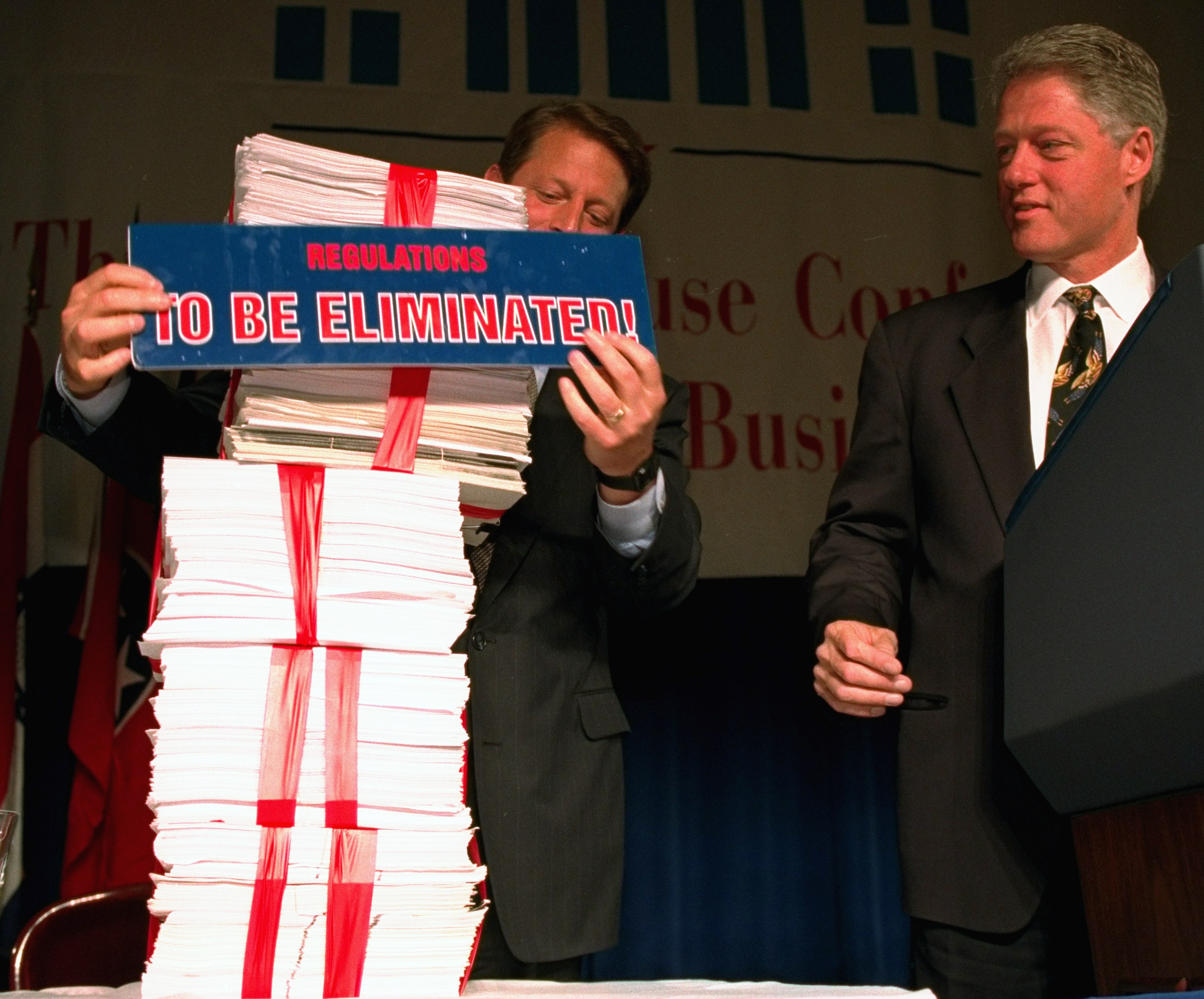
Some efforts met with resistance, recalled Paul Light. But many in the Clinton administration believed "hardworking feds needed to be liberated from rules." New administrations in both parties oftentimes barrel in eager for activity, Light said. The departure is that Democrats tend to understand that implementation requires federal employees, he said.
"Federal employees, to their credit, are committed to faithfully executing the laws" no affair what party holds the White House, Light added. "They don't and shouldn't change with each administration."
Kamarck, writer of Why Presidents Fail and How They Can Succeed Again, said, "Presidents become themselves in trouble by not understanding the bureaucracy." In whatsoever organization of two million people, there is something going wrong and something going right at any given time. Just fifty-fifty in times of crisis, the postal service gets delivered, taxes are collected, Social Security checks go out and community inspectors protect the borders.
Federal employees follow the law, non the president. If Trump walked into the Agronomics Department and proposed to carelessness milk supports, the employees would "probably desire selfies with him," she said, merely would then say, "Mr. President, thank you very much, merely we can't do that, information technology's confronting the constabulary."
Trump's Dilemma
Trump experienced a rare moment of bipartisan support in April, when he authorized the launch of 59 cruise missiles into Syria afterward its government used chemical weapons. He couldn't take done information technology without an administrative state. "They can criticize the deep land all they want, but why 59 missiles, why that time of day, and why was it aimed at that particular spot in the desert?" asked Kettl. When Trump made a policy determination, "it was executed in a way that only people who knew what they were doing could do it."
The Trump administration'southward skepticism about the deep state has led to a number of self-inflicted crises and prompted endless discussion almost the president'due south controlling process. The questions include why he issued a court-blocked travel ban last February without consulting Justice or the Homeland Security Department. Why he tweeted a promise to remove LGBTQ service members from the armed services without looping in the Pentagon. Why he threatened North korea with "burn and fury" without a squad of strange policy specialists molding the linguistic communication.
Ornstein bemoans what he sees every bit Trump'southward "state of war on expertise, war on science," equally revealed in his "dismantling" of science advisory panels on the surround. He complains that Secretary of Country Rex Tillerson is "driving out some of the all-time and brightest career diplomats out of sheer incompetence, ignorance, indifference, and hostility."
At that place's a paradox, added Kettl, in complaining about a deep state then taking such a long fourth dimension to make political appointments. While the administration has an ambitious calendar, without appointees in place to implement its plans, it is reliant on career staff to get the work done.
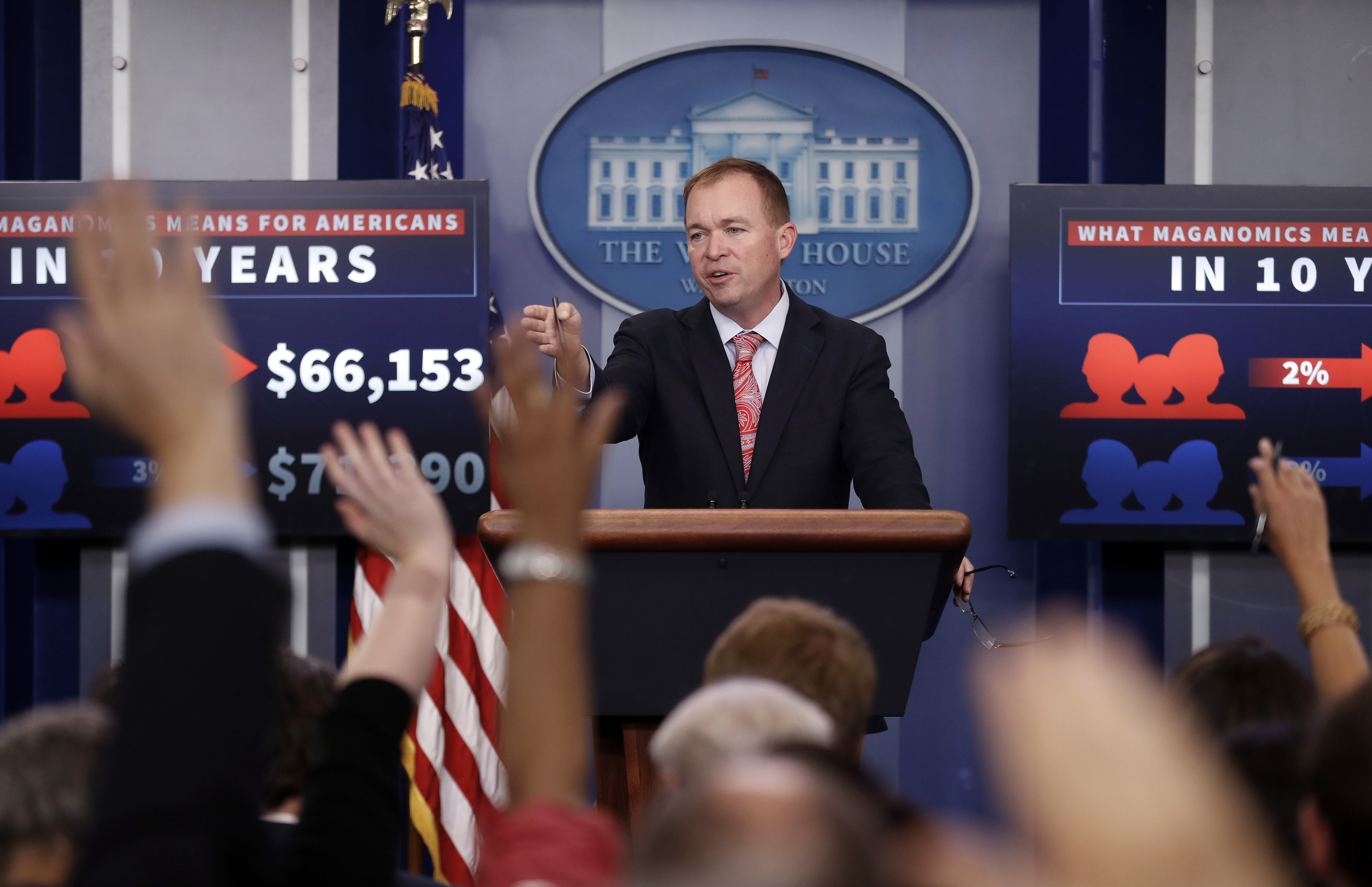
The one area where Trump's staff accept demonstrated respect for career employees may be his management calendar with its proposed bureau reorganizations to boost efficiency. Budget Managing director Mick Mulvaney, in tasking agencies to submit reform proposals, has stressed that his team is talking to the Regime Accountability Office, the President's Management Quango, bureau inspectors general also equally countless federal employees. "It is driven by career staff," he told Regime Executive. "In that location'southward no way a political similar me from the exterior could do it."
Career employees "are the backbone of ensuring that programs are implemented, people are kept safe, and the government performs its part in providing economic opportunity," said Chris Lu, the former deputy Labor secretary. "I probably spent much of my fourth dimension with budget people and lawyers and information technology experts. The career employees understand a new administration wants to point the ship in a dissimilar direction, merely they tell you how far you can turn it, how aggressively to move. Listening to them can make the difference in whether or not a policy change is successfully implemented or whether a regulation holds upwardly in courtroom."
The label deep state "assumes there's some kind of planned conspiracy going on," said Devine, the Reagan-era veteran who still bemoans the obstacles to firing federal employees. "It is irrational to allow people to run around government doing anything they want, simply post-obit the parochial interests of their agencies. Federal employees demand and legally require political supervision, which was the essence of the Carter reforms, a lesson that the Trump administration Function of Management and Budget needs to explain to the White House rather than promoting a naïve version of the permanent bureaucracy."
EPA alumnus Hanley addressed the deep state past recalling the fourth dimension doomed EPA Administrator Burford showed up at a retirement party for longtime bureau luminary Ed Turk. Having picayune to fright from the authorities on his final day, Turk told Burford, "Anne, I'll exit you with this thought:
"When Democrats come to Washington, they go far as an army of liberation. They plough to the ceremonious service and say, `We beloved you, get along and let ane,000 flowers blossom.' Then comes the madness, and the Democrats wake up," Turk said. "So the Republicans make it equally a conquering army and put their heels on the neck of the ceremonious service. But after about a twelvemonth or 18 months, they realize that they actually demand them to run the place. Then they accept their heels off the necks, and things are fine."

Charles S. Clark joined Government Executive in the fall of 2009. He has been on staff at The Washington Post, Congressional Quarterly, National Journal, Time-Life Books, Tax Analysts, the Association of Governing Boards of Universities and Colleges, and the National Heart on Education and the Economy. He has written or edited online news, daily news stories, long features, wire copy, magazines, books and organizational media strategies.
boshearsthille1956.blogspot.com
Source: https://www.govexec.com/feature/gov-exec-deconstructing-deep-state/
0 Response to "â€å“if You Don t Like Our President You Can Leave and Never Come Back Again"
Post a Comment