Doing the Same Thing Again Term
Albert Einstein? Al-Anon? Narcotics Anonymous? Max Nordau? George Bernard Shaw? Samuel Beckett? George A. Kelly? Rita Mae Brownish? John Larroquette? Jessie Potter? Werner Erhard?
 Dear Quote Investigator: It's foolish to repeat ineffective actions. One popular conception presents this signal harshly:
The definition of insanity is doing the same thing over and over again and expecting a different effect.
These words are unremarkably credited to the acclaimed genius Albert Einstein. What do you lot think?
Quote Investigator: There is no noun evidence that Einstein wrote or spoke the statement higher up. It is listed inside a department called "Misattributed to Einstein" in the comprehensive reference "The Ultimate Quotable Einstein" from Princeton University Printing. [i] 2010, The Ultimate Quotable Einstein, Edited by Alice Calaprice, Department: Misattributed to Einstein, Quote Page 474, Princeton University Press, Princeton, New Jersey. (Verified on paper)
The earliest strong match known to QI appeared in Oct 1981 within a Knoxville, Tennessee newspaper article describing a coming together of Al-Betimes, an organization designed to help the families of alcoholics. The journalist described the "Twelve Steps" of Al-Anon which are based on like steps employed in Alcoholics Anonymous. The newspaper began with these two steps: [2] 1981 October 11, The Knoxville News-Lookout man Al-Anon Helps Family unit, Friends to Orderly Lives past Betsy Pickle (Living Today Staff Writer), Quote Page F17, Cavalcade two, Knoxville, Tennessee. (GenealogyBank)
Step one: Nosotros admitted we were powerless over alcohol – that our lives had become unmanageable.
Pace ii: Came to believe that a Power greater than ourselves could restore us to sanity
One of the attendees at the meeting hesitated to accept the accuracy of second step. Emphasis added to excerpts past QI:
Not all the women are willing to acknowledge they needed to be "restored to sanity." In fact, one of them adamantly maintains that she had never reached a betoken of insanity. But another remarks, "Insanity is doing the same thing over and once again and expecting different results."
The second primeval potent match known to QI appeared in a pamphlet printed by the Narcotics Anonymous system in Nov 1981: [3] 1981, Narcotics Anonymous Pamphlet, (Bones Text Approving Form, Unpublished Literary Work), Chapter Four: How It Works, Step Two, Page 11, Printed November 1981, Copyright 1981, W.South.C.-Literature … Continue reading
The price may seem higher for the addict who prostitutes for a set up than it is for the aficionado who merely lies to a medico, simply ultimately both pay with their lives. Insanity is repeating the same mistakes and expecting different results.
QI acquired a PDF of the document with the quotation above on the website amonymifoundation.org dorsum in February 2011. The document stated that is was printed in Nov 1981, and information technology had a 1981 copyright notice. The website was subsequently reorganized, but the certificate remains available via the Internet Archive Wayback Machine database.
Below are additional selected citations in chronological order.
The linkage between insanity and repetition has a long history. The controversial volume "Degeneration" by Max Nordau was published in German in 1892 and translated into English by 1895. Nordau examined the works of a variety of artists and savagely attacked those that contained repetition which he believed evinced a mental defect in the creator. For case, he criticized Maurice Maeterlinck's "La Princesse Maleine": [iv] 1895 Copyright, Degeneration by Max Nordau (Max Simon Nordau) (Translated from the Second Edition of the German Work), Quote Folio 238, D. Appleton and Company. (Google Books Full View) link
Has anyone anywhere in the poetry of the two worlds always seen such complete idiocy? These 'Ahs' and 'Ohs,' this want of comprehension of the simplest remarks, this repetition four or 5 times of the same imbecile expressions, gives the truest conceivable clinical moving picture of incurable cretinism. These parts are precisely those well-nigh extolled by Maeterlinck's admirers.
When George Bernard Shaw reviewed Nordau's opus he turned the criticism of repetition back upon the writer and suggested that Nordau might diagnose himself as mentally unsound: [five] 1895 July 27, Liberty, Volume 11, Number half dozen, A Degenerate's View of Nordau by Bernard Shaw, Quote Folio 2, Column 1, Published by Benj. R Tucker, New York. (Reprint in 1970 by Greenwood Reprint … Continue reading
I have read Max Nordau's "Degeneration" at your asking,—ii hundred and threescore g mortal words, maxim the same thing over and over again. That, as yous know, is the way to drive a thing into the mind of the world, though Nordau considers it a symptom of insane "obsession" on the part of writers who do non share his own opinions. His bulletin to the world is that all our characteristically modernistic works of art are symptoms of disease in the artists, and that these diseased artists are themselves symptoms of the nervous burnout of the race past overwork.
The 1955 volume "The Psychology of Personal Constructs" by George A. Kelly included a definition that corresponded to the proverb under investigation although information technology employed a different vocabulary: [6] 1955, The Psychology of Personal Constructs by George A. Kelly, Volume 2: Clinical Diagnosis and Psychotherapy, Quote Page 831, Published past W. West. Norton & Company, New York. (Verified on paper)
From the standpoint of the psychology of personal constructs we may define a disorder as whatever personal structure which is used repeatedly in spite of consistent invalidation. This is an unusual definition, equally psychological thinking commonly goes.
In October 1981 an educator and advisor on family relationships delivered a spoken communication containing a thematically related adage: [vii] 1981 October 24, The Milwaukee Watch, Search For Quality Called Central To Life by Tom Ahern, Quote Folio 5, Column 5, Milwaukee, Wisconsin. (Google News Archive)
"If you ever do what you've ever done, you always get what yous've e'er gotten." That was the advice of Jessie Potter, the featured speaker at Friday's opening of the seventh annual Woman to Woman conference.
More information about the quotation higher up is available here.
In October 1981 the saying was spoken by an attendee of an Al-Anon meeting equally noted previously:
Insanity is doing the same thing over and over again and expecting different results.
In November 1981 a pamphlet from Narcotics Anonymous contained a close match every bit noted previously:
Insanity is repeating the same mistakes and expecting unlike results.
The 1983 novel "Sudden Expiry" by Rita Mae Brown included an instance credited to Jane Fulton who was a character within the book: [8] 1983, Sudden Death by Rita Mae Dark-brown, Affiliate 4, Quote Page 68, Published by Bantam Books, New York. (Verified with scans)
The trouble with Susan was that she made the same mistakes repeatedly. She'd fall in love with a woman and consume her. Susan thought that her mere presence was enough. What more was in that location to give? When she tired, usually after a year or and so, she'd find some other woman.
Unfortunately, Susan didn't call back what Jane Fulton once said. "Insanity is doing the aforementioned matter over and once again, merely expecting unlike results."
A June 1983 book review of "Sudden Death" in "The Clarion-Ledger" of Jackson, Mississippi reprinted the saying: [9] 1983 June nineteen, The Clarion-Ledger, "Sudden Expiry" a complex metaphor by Stephen L. Silberman, (Book review of "Sudden Death" past Rita Mae Brown), Quote Page 7H, Column 2, … Go on reading
Women's tennis gets a thorough dissecting in this story. Jane Fulton is the critical sports writer who contends "Modern professional sports rewards players for role instead of character. Responsibility is normally defined every bit doing a chore better than anyone else." She looks askance at professional tennis and says "Win and get a god. Lose and be forgotten." Finally after following the lives and careers of the players, and the game itself, she concludes, "Insanity is doing the aforementioned thing over and over and over again, just expecting different results."
Also in 1983 Samuel Beckett, winner of the Nobel Prize in Literature, offered a counterpoint perspective in his work "Worstward Ho": [10] 1983, Worstward Ho by Samuel Beckett, Quote Page 7, Grove Press Inc., New York. (Verified with scans)
All of onetime. Cipher else ever. Always tried. E'er failed. No affair. Try again. Fail again. Neglect better.
In January 1986 the Emmy-winning player John Larroquette who was a star in the boob tube comedy series "Dark Court" shared the definition during a newspaper interview: [eleven] 1986 January 5, The Sydney Morning Herald, Television with Jacqueline Lee Lewes: From drugs, drinkable to… Nighttime Court: 'Confessions of an Emmy Star, Quote Page 31, Column 3, Sydney, New … Go on reading
He pops in a definition of insanity – "It's the repetition of the aforementioned activeness expecting different results. Like jumping out of a 40-storey edifice, breaking every os, spending half dozen months in infirmary, going back to the same building, up to the 39th flooring, jumping and expecting information technology to be different. Information technology is NEVER dissimilar."
In Apr 1986 an opinion piece past Baltazar A. Acevedo Jr in "The Dallas Morning News" of Texas included the saying: [12] 1986 April 25, The Dallas Morn News, Leadership Beyond Ethnicity Should Be Goal of Dallasites by Baltazar A. Acevedo Jr., Dallas, Texas. (NewsBank Admission World News)
I once heard insanity defined equally a process by which an individual or a organization does something over and over once more in the aforementioned mode while yet expecting different results. To continue to evaluate and address problems in our customs strictly along ethnic, instead of human, considerations is insane if only for one reason: It volition lead to the polarization that is the standard of paranoid societies.
The 1988 volume "Raising Cocky-Reliant Children in a Cocky-Indulgent Earth" included an instance: [xiii] 1988 Copyright, Raising Cocky-Reliant Children in a Self-Indulgent Earth: Seven Building Blocks for Developing Capable Young People by H. Stephen Glenn and Jane Nelsen, Quote Page 174, Published by … Continue reading
Flexibility is the ability to bend when nosotros find ourselves in unworkable positions. A universal characteristic of insanity is inflexibly doing the aforementioned thing over and over while hoping for different results. Flexibility in the face of changing circumstances, by contrast, is a hallmark of mental wellness.
By 1990 the proverb was being attributed to Einstein. For instance, the "Austin American-Statesman" of Austin, Texas published the following remark made past Travis Canton District Chaser Ronnie Earle: [fourteen] 1990 November xix, Austin American-Statesman, Department: News, Prison Puzzle – Threat of price explosion poses hard choices past Mike Ward, Quote Page A1, Austin, Texas. (NewsBank Admission World … Keep reading
Einstein one time said that insanity is doing the aforementioned thing over and over and expecting a different result.
In 1991 "The Seattle Times" printed the thoughts of an Indiana guess who ascribed another version of the maxim to Einstein: [15] 1991 July 4, The Seattle Times, Department: Editorial, Getting Out of the Freedom Business by Don Williamson, Quote Page A8, Seattle, Washington. (NewsBank Access World News)
The jurist from the Hoosier Country subscribes to Albert Einstein's definition of insanity: "doing the same thing over and over and expecting a unlike outcome."
In 2000 a columnist working for the Knight Ridder News Service ascribed a version of the proverb to the influential lecturer and trainer Werner Erhard although the proper name was misspelled as "Erhart": [16] 2000 July 30, The Indianapolis Star, Become a programme to overcome problem spots past Tim O'Brien (Knight Ridder News Service), Quote Page J3, Column 1, Indianapolis, Indiana. (Newspapers_com)
Werner Erhart described insanity as 'repeating identical behavior and expecting a dissimilar issue.' If nosotros repeatedly have difficulties in an expanse of life, doesn't information technology make sense that our behaviors cause the problems?
In 2016 the webcomic "xkcd" depicted two characters conversing; the start mentioned the now well-known definition of insanity, and the 2nd replied with a remark that implicitly and cleverly applied the logic of the definition to his companion: [17] Website: xkcd Comic, Comic title: Insanity, Comic author: Randall Munroe, Date on website: March eighteen, 2016, Website description: A webcomic of romance, sarcasm, math, and language. (Accessed xkcd.com … Proceed reading
Yous've been quoting that cliché for years. Has it convinced anyone to modify their mind however?
In conclusion, based on current prove the proverb originated in one of the twelve-step communities. Anonymity is greatly valued in these communities, and no specific author has been identified by the many researchers who take explored the provenance of this adage. The linkage to Albert Einstein occurred many years after his death and is unsupported.
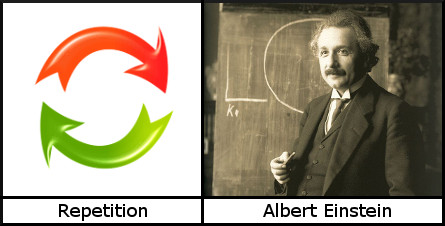
Image Notes: Two arrows pointing at one another from OpenClipart-Vectors at Pixabay. Portrait of Albert Einstein circa 1921 by Ferdinand Schmutzer accessed via Wikimedia Commons. Images have been retouched, cropped and resized.
(Nifty thanks to MJ Redman, Kevin Ashton, Melinda Denson, Linda Sternhill Davis, The Muser, Mededitor, Santanu Vasant, Simon Lancaster, Michael Cochran, David Meadows, J Carson, Guilherme Simões, Ed Darrell, Lee Winkelman, and Fabius Maximus (Ed.) whose inquiries led QI to formulate this question and perform this exploration. Special cheers to the volunteer researchers Quora and Wikiquote who mentioned the Narcotics Anonymous citation. Also, thanks to the valuable research conducted by Barry Popik, Ben Zimmer, and Daniel Gackle. Many thank you to Neb Mullins who located the important Oct 11, 1981 citation.)
Update History: On July 31, 2019 the October 11, 1981 citation was added to the article.
boshearsthille1956.blogspot.com
Source: https://quoteinvestigator.com/2017/03/23/same/
0 Response to "Doing the Same Thing Again Term"
Post a Comment